This deck is a trick deck wherein the backs of the cards used have a thick, non-slick surface. The cards are placed back to back in certain pairs. There a few rules in determining these pairs: * 1) Each pair adds up to 13 (9 and 4; 6 and 7; qu... Read more of Invisible Deck at Card Trick.caInformational Site Network Informational
Privacy
Home Gardening in General Fruits & Vegetables Plants & Flowers
Articles - Directory - Indoor Gardening - Small Gardens Cucumbers - Apple Growing - Asparagus - Walnut Growing - Vegetables Flowers - Clovers

Most Viewed

Wild Lupine Old Maid's Bonnets Wild Pea Sun Dial
Dutchman's Pipe Pipevine
Yellow And Orange Flowers
Pitcherplant Sidesaddle Flower Huntsman's Cup Indian Dipper
Pointed Blueeyed Grass Eyebright Blue Star
Moonshine Cottonweed Nonesopretty
Plant Garden Stonecrop Witches' Money
Magenta To Pink Flowers
From Blue To Purple Flowers
Wild Blue Phlox


Least Viewed

Erica Cerinthoides Honeywort-flower'd Heath
Struthiola Erecta Smooth Struthiola
Michauxia Campanuloides Rough-leav'd Michauxia
Ipom&oeliga Coccinea Scarlet Ipom&oeliga
Disandra Prostrata Trailing Disandra
Buchnera Viscosa Clammy Buchnera
Lychnis Coronata Chinese Lychnis
Magenta To Pink Flowers
Yellow And Orange Flowers
Bellis Perennis Var Major Flore Pleno Great Double Daisy


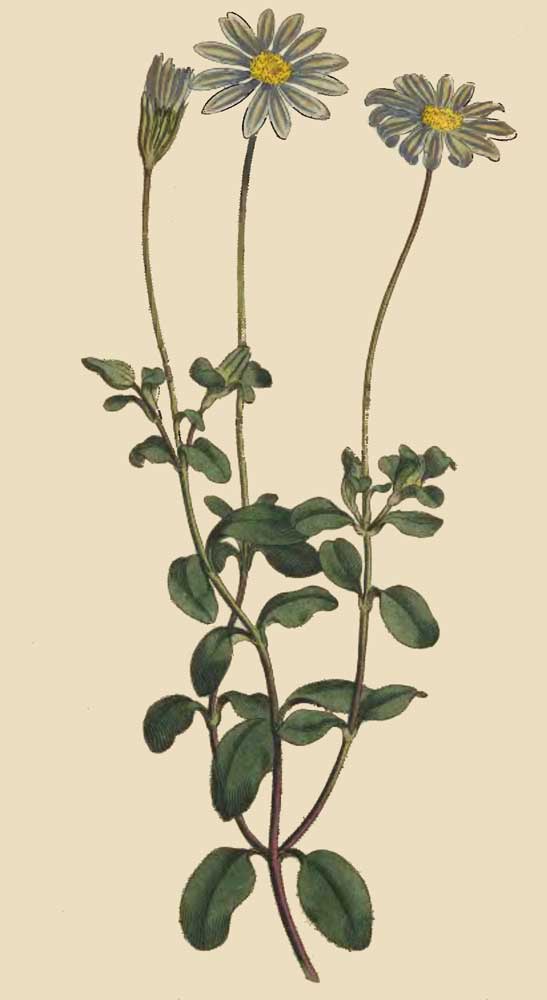
Cineraria Amelloides Blue-flowered Cineraria Or Cape Aster


Class and Order.

Syngenesia Polygamia Superfloa.

Generic Character.

Recept. nullum. Pappus simplex. Cal. simplex polyphyllus æqualis.

Specific Character and Synonyms.

CINERARIA Amelloides pedunculis unifloris, foliis oppositis ovatis nudis, caule suffruticoso. Linn. Syst. Vegetab. ed. 14. Murr. p. 765. Ait Kew. v. 3. p. 219.

ASTER africanus frutescens ramosus, floribus cæruleis, foliis oppositis minimis, caulibus et ramulis in pedunculos nudos exeuntibus. Raii Suppl. 158.

ASTER caule ramoso scabro perenni, foliis ovatis sessilibus, pedunculis nudis unifloris. Mill. Icon. 76. f. 2.
The Cineraria Amelloides a plant common in every green-house, was introduced by Mr. Philip Miller as long since as the year 1753, being raised by him from Cape seeds; it forms a bushy shrub, of the height of two, or three feet, produces numerous blossoms, which stand singly on long footstalks, are of a pale blue colour; they make some amends for their want of brilliancy by flowering during most of the year.

The plant is easily propagated either by seeds or cuttings.


Next: Myrtus Tomentosa Woolly-leaved Myrtle
Previous: Vinca Rosea Madagascar Periwinkle


Add to del.icio.us Add to Reddit Add to Digg Add to Del.icio.us Add to Google Add to Twitter Add to Stumble Upon
Add to Informational Site Network
Report
Privacy
SHAREBOOKMARK


Viewed 225