This deck is a trick deck wherein the backs of the cards used have a thick, non-slick surface. The cards are placed back to back in certain pairs. There a few rules in determining these pairs: * 1) Each pair adds up to 13 (9 and 4; 6 and 7; qu... Read more of Invisible Deck at Card Trick.caInformational Site Network Informational
Privacy
Home Gardening in General Fruits & Vegetables Plants & Flowers
Articles - Directory - Indoor Gardening - Small Gardens Cucumbers - Apple Growing - Asparagus - Walnut Growing - Vegetables Flowers - Clovers

Most Viewed

Wild Lupine Old Maid's Bonnets Wild Pea Sun Dial
Dutchman's Pipe Pipevine
Yellow And Orange Flowers
Pitcherplant Sidesaddle Flower Huntsman's Cup Indian Dipper
Pointed Blueeyed Grass Eyebright Blue Star
Moonshine Cottonweed Nonesopretty
Plant Garden Stonecrop Witches' Money
Magenta To Pink Flowers
From Blue To Purple Flowers
Wild Blue Phlox


Least Viewed

Erica Cerinthoides Honeywort-flower'd Heath
Struthiola Erecta Smooth Struthiola
Michauxia Campanuloides Rough-leav'd Michauxia
Ipom&oeliga Coccinea Scarlet Ipom&oeliga
Disandra Prostrata Trailing Disandra
Buchnera Viscosa Clammy Buchnera
Lychnis Coronata Chinese Lychnis
Magenta To Pink Flowers
Yellow And Orange Flowers
Scabiosa Atropurpurea Sweet Scabious


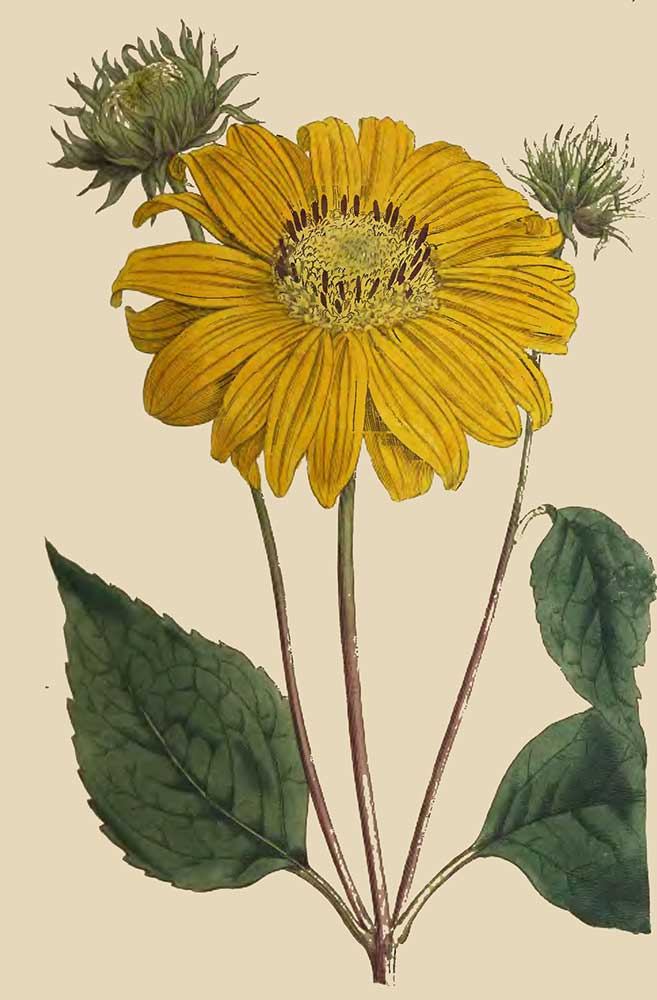
Helianthus Multiflorus Many-flowered Or Perennial Sun-flower


Class and Order.

Syngenesia Polygamia Frustranea.

Generic Character.

Recept. paleaceum, planum. Pappus 2-phyllus. Cal. imbricatus, subsquarrosus.

Specific Character and Synonyms.

HELIANTHUS multiflorus foliis inferioribus cordatis trinervatis superioribus ovatis. Linn. Syst. Vegetab. ed. 14. Murr. p. 781.

CHRYSANTHEMUM americanum majus perenne, floris folis foliis et floribus. Moris. Hist. 3. p. 23.

The Helianthus multiflorus, a native of North-America, is a hardy perennial herbaceous plant, arising usually to the height of five or six feet, and producing a great number of large yellow shewy blossoms, which renders it a suitable plant to ornament the shrubbery or garden of large extent; the variety with double flowers is the one most commonly cultivated, and this we find in almost every garden: it flowers from July to September, and is propagated by parting its roots in autumn.

This is a hardy plant, of ready growth, will bear the smoke of London better than many others; if it continues in the same spot for a great number of years, the blossoms are apt to become single.

The single sort, according to Morison, was introduced before 1699 by Lord Lemster. Ait. Kew.


Next: Bellis Perennis Var Major Flore Pleno Great Double Daisy
Previous: Arabis Alpina Alpine Wall-cress


Add to del.icio.us Add to Reddit Add to Digg Add to Del.icio.us Add to Google Add to Twitter Add to Stumble Upon
Add to Informational Site Network
Report
Privacy
SHAREBOOKMARK


Viewed 229